

[ad_1]
In 1921, three years since the end of WWI, a train departed the small town of Aquileia in northeastern Italy. Draped in flags and wreathes, it carried the coffin of an unidentified soldier to his final resting place in Rome. It was a slow, solemn ride. Along the way, crowds gathered to pay their respects––ordinary citizens, widows, and orphans watched the carriages glide past in spectral silence. The journey was immortalized in the 1921 documentary Gloria: Apotheosis of the Unknown Soldier, and glimpses of footage crop up everywhere in Pietro Marcello’s Duse, a film that’s as concerned with charting the last years of the titular Italian actress as it is with mapping out the tempestuous world she traversed. That micro-macro approach has long been Marcello’s preferred M.O.––the same he followed in Martin Eden, which similarly weaved its protagonist’s personal and artistic struggles within the much-larger changes his home turf was undergoing. And though Duse doesn’t scale that film’s heights, it still expands on the director’s project to bridge the distance between past and present, truth and myth.
Marcello is that rare filmmaker whose cinema doesn’t consider “now” and “then” dichotomous planes, but as existing on the same time-space continuum. That’s largely how Martin Eden avoided the stuffy quality of many other period dramas. In adapting Jack London’s 1909 novel, he and co-scribe Maurizio Braucci swapped the source text’s original setting––turn-of-the-century Oakland––for Naples. It was a bold gambit that paid off beautifully, not least because the journey was resolutely unmoored in time. Anachronisms abounded: if the costumes suggested the 1930s, a few TV sets in the background pointed to later decades, with other décor and Italian pop songs further complicating your bearings. Crucial to that disorientation has always been Marcello’s handling of archival footage; as in all his previous features, Martin Eden didn’t just include a few snippets of life in early-20th-century Italy but seamlessly merged them into Alessandro Abate and Francesco Di Giacomo’s 16mm cinematography, obfuscating temporal markers as well as the line between pre-existing clips and Marcello’s own material. That his work, at their most entrancing, cultivates a peculiar dislocation is why the more straightforward Duse registers as an outlier.
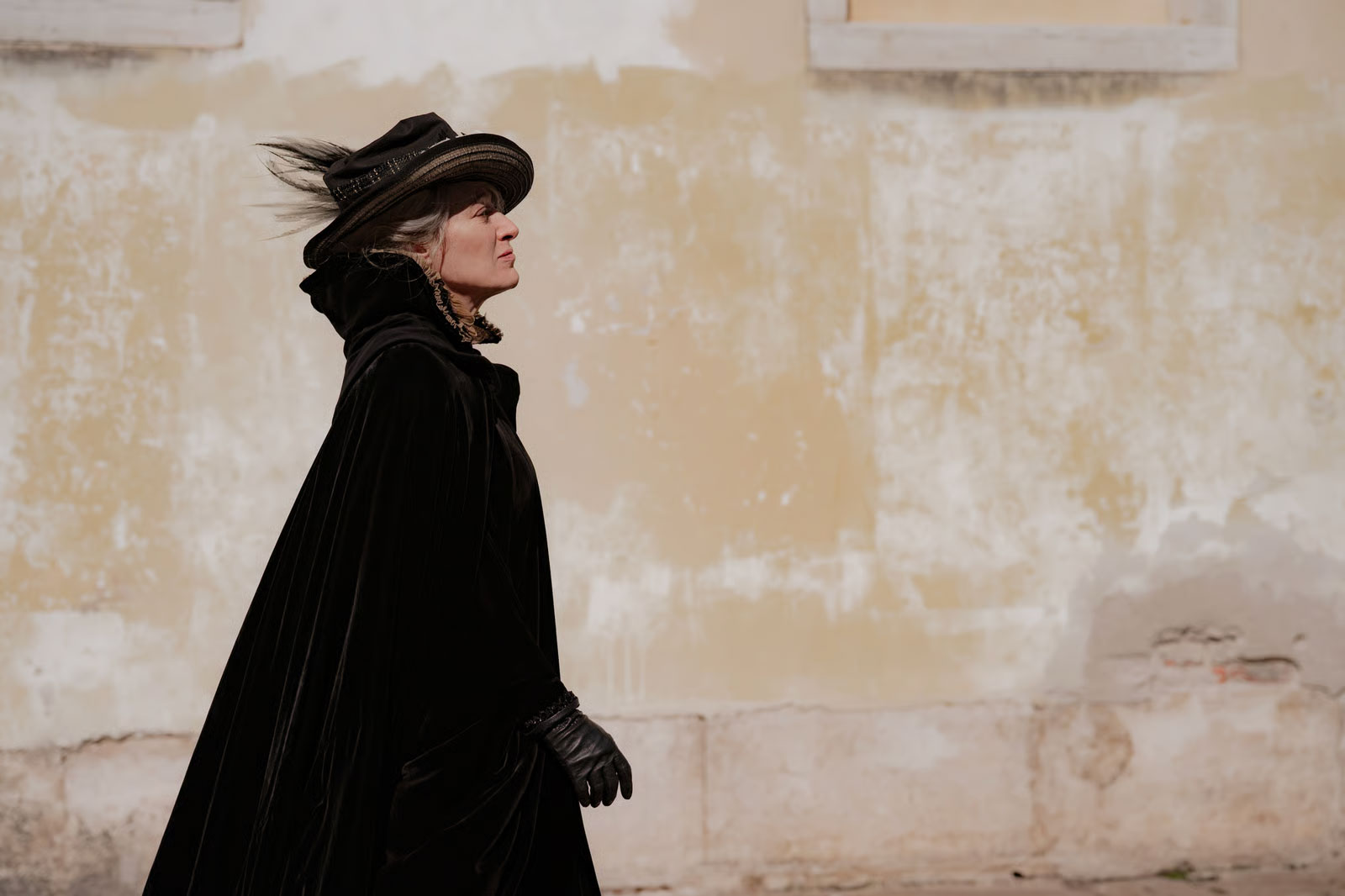
Written by Marcello, Letizia Russo, and Guido Silei, the film follows Eleonora Duse (Valeria Bruni Tedeschi) as she returns to the stage from a 12-year absence. Arguably the greatest theatre actress of her generation––so revered by critics and audiences as to be granted the title “La Divina”––her comeback is a landmark event, and the premiere of the Ibsen play she stars in after the hiatus is attended by throngs of aristocrats and politicians (among them then-MP Benito Mussolini). That’s not his only cameo; Marcello ties the woman’s second round under the spotlight with Italy’s own rise from the ashes of WWI and inexorable slide into fascism.
There’s a thematic continuity in the way power corrodes the artist: Martin Eden charted its protagonist’s descent from youthful idealist to affluent if spiritually broken literary icon, while Duse suggests a similar downward spiral, dogging Eleonora and her creative and sentimental partner, Gabriele D’Annunzio (Fausto Russo Alesi), as they become smitten with Mussolini’s regime, only to wake up––all too late––to its cancerous grips on society and the arts. But Eleonora, a thespian who resumed working in 1921, offers Marcello a chance to tease out other anxieties. No one ever doubts her exquisite skills. Less clear is why she’d insist on playing “the classics” after an earth-shattering event like WWI, or why she’d so vehemently reject the chance to work in the newborn cinema. The world’s changing, a new medium is on the rise, the kind of theatre Duse excelled at is becoming obsolete.
These are frictions Bruni Tedeschi embodies with emphatic conviction. She incarnates Eleonora as a cross between a wide-eyed child and spiteful diva eager to champion younger writers, only to dump them when their talents fail to measure up to hers. And she only needs to use her face to convey the Divina’s feverish charisma. Marco Graziaplena’s handheld camerawork largely captures her through close-ups of her visage, a choice that goes hand-in-hand with Marcello’s decision to not show her at work. That’s because Duse isn’t particularly concerned with giving us tangible evidence of its heroine’s genius––only briefly is she seen acting. Sparing Bruni Tedeschi from having to recreate the prima donna’s own performances helps Duse steer clear of some of the kitschy, well-trodden formulas of many an artist biopic. But it also doesn’t entirely explain why she should be worshipped by hordes of admirers––all we’re left with is Bruni Tedeschi’s mercurial turn, and that alone doesn’t justify the hagiography.
More worryingly, Duse features little of the dizziness that made Marcello’s previous work so transportive. Here, too, the director disseminates archival clips, but the old footage doesn’t open up Duse in the same confounding ways it did Martin Eden. Marcello’s target isn’t the blurring of your temporal coordinates but the divide between fact and fiction. Nothing exemplifies that better than a late scene that sees D’Annunzio address crowds of fascists from a balcony, with Marcello overlapping Russo Alesi’s voice with a recording of the real-life poet giving that same speech in the early 1920s. It’s a choice that befits a story about artists who treated the world as an extension of the stages they walked. But while there’s no denying the disquiet that comes from watching film and history collide, the overall journey is surprisingly linear. Duse testifies to Marcello’s ability to turn his frames into porous, breathing tissue, and wield archives to narrow the gap between Italy’s horrific past and the ghosts haunting it today. But if his late-life tribute to a legendary artist is spared from the museological qualities of other dramas of its ilk, it still keeps its heroine and her world shrouded in mystery.
Duse premiered at the 2025 Venice Film Festival.
[ad_2]

1 Comment
Your point of view caught my eye and was very interesting. Thanks. I have a question for you.